Multi-tenant deployment guide
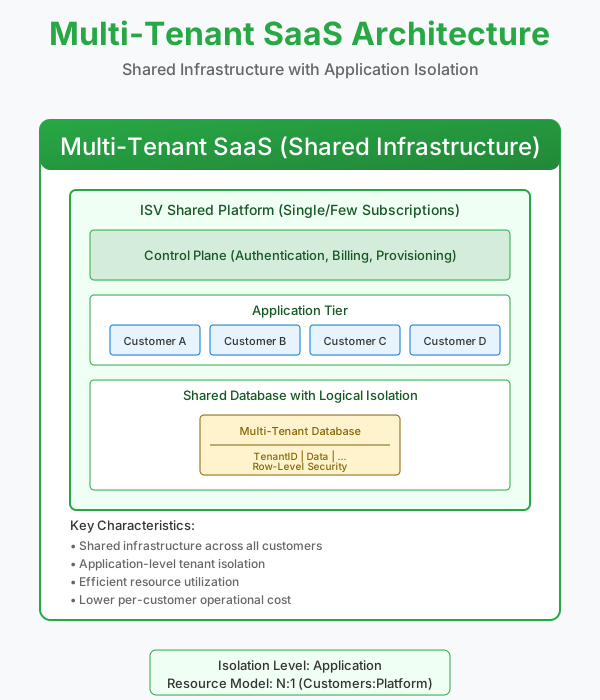
Use this guide for SaaS offerings where multiple customers share a centralized platform. The ISV landing zone guidance describes these scenarios as "pure SaaS" or "dual-deployment" models, depending on whether customers also receive dedicated environments. You'll use this guide to plan tenant isolation, deployment stamps, and supporting services that maintain reliability at scale.
Critical subscription service limits
WARNING: Azure subscription service limits impose hard architectural constraints that affect multi-tenant designs far more than quota limits. These aren't negotiable—they're platform constraints that dictate your architecture:
Storage account limits
- 250 storage accounts per region per subscription (500 with support request)
- If you isolate customer data in separate storage accounts, you hit a scaling wall at 250 tenants
- Each storage account limited to 40,000 requests/second in primary regions
- Maximum 200 private endpoints per storage account limits network isolation options
Resource group constraints
- 980 resource groups per subscription maximum
- 800 resources per resource group, per resource type
- If you use resource groups for tenant isolation, you're capped at 980 tenants per subscription
- Tagged resource groups further reduce this limit
Compute and app limits
- 100 App Service plans per resource group
- 100 function apps per subscription (Consumption tier)
- 512 access restriction rules per app constrains IP-based tenant isolation
Network isolation boundaries
- 200 private endpoints per app service
- Virtual network limits vary by region and subscription type
- Network security group rules have regional caps
These service limits force critical architectural decisions from day one. Unlike quotas that you can request increases for, these are immutable platform constraints that determine whether you need multiple subscriptions, how you isolate tenants, and when you must implement deployment stamps.
Architectural principles
- Balance all Well-Architected pillars. SaaS providers must design for reliability, security, cost, operations, and performance simultaneously. Evaluate trade-offs for each release and document how they affect tenant experience.
- Adopt Zero Trust and least privilege. Isolate tenants through identity, networking, and data segmentation. Combine resource-level controls with application-layer enforcement to prevent cross-tenant leakage.
- Design within service limits. Unlike quotas, subscription service limits are fixed platform constraints. Architecture decisions must accommodate these non-negotiable boundaries.
Deployment stamps and control planes
- Shared deployment stamps. Use the Deployment Stamps pattern to scale out infrastructure units that each host multiple tenants. Stamps simplify safe deployment, progressive rollout, and regional expansion.
- Control plane design. Separate centralized services (portal, onboarding pipeline, provisioning API) from tenant workloads. The control plane coordinates stamp creation, tenant placement, and lifecycle operations.
- Zone alignment for stamps. When stamps span multiple subscriptions, run
scripts/quota/Get-AzAvailabilityZoneMapping.ps1to verify logical-to-physical zone mappings. Azure randomizes zone assignments per subscription, so logical zone 1 in subscription A may map to a different physical datacenter than zone 1 in subscription B. This script reveals actual mappings for proper fault domain alignment.
Tenancy model decisions
- Resource sharing tiers. Decide which components remain multitenant (for example, compute cluster, databases) versus per-tenant. Factor in cost modeling, noisy-neighbor risk, and customer-specific compliance commitments.
- Governance and monitoring. Instrument per-tenant metrics and quotas even when tenants share resources. This enables proactive detection of overconsumption and supports usage-based billing.
Data architecture
- Data store selection. Choose transactional data stores that match workload needs (relational vs. nonrelational) and support tenant growth. Minimize the number of technologies to reduce operational complexity.
- Isolation strategies. Implement database-per-tenant, schema-per-tenant, or shared tables with tenant keys depending on compliance and scale requirements. Remember that storage account limits (250 per region) constrain per-tenant storage isolation—plan for multi-subscription architectures before you hit these walls.
- Scale planning. Document how you enforce tenant-level backup, restore, and data residency guarantees within service limits. Storage-account-per-tenant architectures fail at 250 tenants without proactive subscription scaling strategies.
Operational excellence
- Safe deployments. Use progressive exposure (rings, feature flags) when rolling out new releases across stamps. Monitor health signals per tenant and stamp to trigger rollbacks based on clear thresholds and policies.
- Cost governance. Track cost of goods sold (COGS) per tenant and align pricing tiers with resource consumption. Automate reporting so finance teams can adjust pricing or optimize resource allocation.
Landing zone integration
- Build the underpinning Azure landing zone with ISV guidance to guarantee management groups, policy assignments, and cross-subscription networking support multitenant growth.